

Spirulina

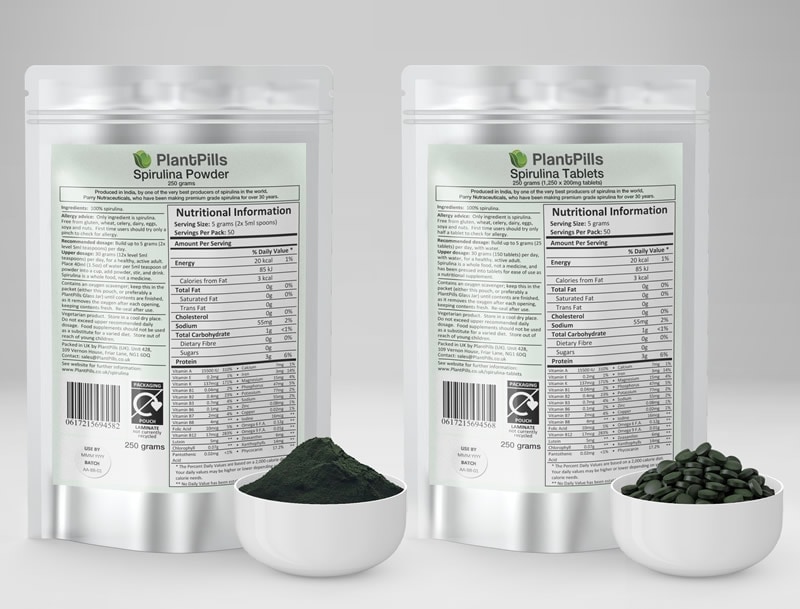
    PlantPills Spirulina Pouche Tablets and Powder

    Nature’s multivitamin: the most concentrated and nutritious whole food known to science.

    What is spirulina?

    Spirulina is a tiny single-celled blue-green alga that lives in fresh water. It's a plant that has existed on earth for over 3 billion years, is about half a millimetre in length, and appears under a microscope as long, thin, blue-green spiral threads. Strong sunlight, pure water and clean air enable spirulina to thrive, but it is highly adaptable, and is known to survive in extremely harsh conditions.

    Spirulina is said to have been consumed in Mexico City as the primary source of protein for 5,000 years. Today, millions of people worldwide use spirulina daily, but it is most commonly consumed in the far east; Japan is the world’s largest consumer.

    Spirulina is considered one of the most nutritious foods on Earth, and NASA has used spirulina for astronauts in space. In the 1974 United Nations World Food Conference, it was announced that spirulina is “the most ideal food for mankind”. The World Health Organisation considers it “a very suitable food” and “able to be administered to children without any risk”, while The United Nations has said “there is a need for both national governments and inter-governmental organizations to re-evaluate the potential of spirulina to fulfil both their own food security needs as well as a tool for their overseas development emergency response efforts”.

    Why PlantPills spirulina?

    PlantPills spirulina is grown in vast mineral rich fresh water “raceway” type ponds by Parry Nutraceuticals in India, the only spirulina producer in the world to be certified by the U.S. Pharmacopeial Convention (USP) under their Dietary Ingredient Verification Program. Parry have been cultivating spirulina for over 30 years, and are acknowledged to be among the very best producers of spirulina in the world.

    PlantPills spirulina (Arthrospira platensis) contains more gamma linolenic acid (GLA), vitamin K, vitamin B2, chlorophyll and crude phycocyanin than any other known source in the world.

    A concern for anyone who consumes spirulina is the potential contamination of spirulina with blue green algae strains of AFA (Aphanizomenon flos-aquae), some of which produce microcystins, which are known to be hepatoxic (toxic to the liver) and carcinogenic (cancer causing).

    PlantPills spirulina tests negative for microcystins, at a stringent detection limit of half a part per billion. It also tests negative for the neurotoxin BMAA. Frankly, if every batch of spirulina is not tested to this level, it cannot be deemed certain to be safe for human consumption.

    PlantPills spirulina is cultivated using vegetarian organic nutrients (no animal products or Chilean Nitrate are added), is suitable for vegans, is non-GMO, is gluten free, herbicide and pesticide free, and although Parry have obtained organic certifications from USDA and OCIA (USA), Ecocert (France), and Naturland (Germany), PlantPills has not yet applied for organic certification in the UK, so we can not yet claim that our spirulina is organic, and do not sell it as organic.

    PlantPills spirulina comes in powder or 200 mg tablets, significantly smaller and easier to take than the larger 500mg supplied by the majority of producers.

    Pack sizes are 250 grams, 500 grams, 1 kilogram, 2 kilograms and 10 kilograms (selectable in the basket).

    PlantPills

    Independent third-party laboratory test certificate history

    Before buying a food supplement, ask for the original independent third-party laboratory certificates for its current batch. These should cover heavy metals and microbiological activity, with identity and purity testing where relevant.

    The laboratory should be reputable and independent of both the manufacturer and retailer. Its reports should identify the material tested, the methods used and the results. This helps check authenticity and assess contamination against the stated specifications; a supplier’s own figures do not provide the same independent evidence.

    Original reports help identify misidentified or contaminated material; without them, claimed purity or contamination figures cannot be independently checked. To compare products fairly, compare certificates for the current batches, using equivalent tests, units and methods—not numbers copied onto a website.

    PlantPills commissions independent testing for each batch, including heavy metals and microbiological tests and identity or purity testing where applicable. The original certificates for current and previous batches are provided below.

    Certificate history

    PlantPills Spirulina tablets and powder

    Current batch: YA-AD-03

    Current batch

    Batch YA-AD-03

    Batch YA-AD-03 is the current Spirulina batch.

    The heavy-metals report is dated 2 June 2025 and the microbiology certificate is dated 24 May 2025. They record the named results below and do not represent testing of categories not shown.

    Current report links
    Independent third-party laboratory test results for batch YA-AD-03, as detailed in the above reports
    Test Reported result Method
    Heavy metals Lead (Pb) 0.038 ppm (mg/kg); arsenic (As) 0.055 ppm; cadmium (Cd) 0.010 ppm; mercury (Hg) not detected. ICP
    Microbiology Total viable plate count 60 cfu/g; mold, yeast and coliforms not detected; E. coli, Pseudomonas, Staphylococcus aureus and Salmonella absent. Not stated
    Previous batches and earlier report links 12 reports

    Batch WI-AB-03

    Batch WI-AB-03 has the following laboratory reports. The independent third-party heavy-metals report dated 13 March 2023 records, by ICP, lead at 0.032 ppm, arsenic at 0.06 ppm, cadmium at 0.01 ppm and mercury at 0.002 ppm. The microbial Certificate of Analysis dated 7 March 2023 records a total plate count of 20 cfu/gm; yeast, mould and coliforms were not detected, and E. coli, Pseudomonas, Staphylococcus aureus, Salmonella and Shigella were recorded absent.

    Report links

    Batch TC-AE-03

    Batch TC-AE-03 has the following laboratory reports. The independent third-party heavy-metals report dated 20 August 2020 records, by ICP, lead at 0.051 ppm, arsenic at 0.053 ppm and cadmium at 0.016 ppm; mercury was reported not detected. The microbial Certificate of Analysis dated 21 August 2020 records a total plate count of 1,000 cfu/gm, with yeast, mould and coliforms not detected, and E. coli, Pseudomonas, Staphylococcus aureus, Salmonella and Shigella recorded absent. A separately identified in-house Certificate of Analysis dated 18 June 2020 records protein at 68.87%, chlorophyll at 1.78% and crude phycocyanin at 18.43%.

    Report links

    Source lot PST-044-CNK-13-14 — Parry's Organic Spirulina Tablet

    This manufacturer Certificate of Analysis from Parry Nutraceuticals, Division of E.I.D. Parry (India) Ltd, is dated 15 July 2013 and identifies Parry's Organic Spirulina Tablet, source lot PST-044-CNK-13-14. It reports protein at 65.7 g/100g by the Dumas method (N × 6.25). The ICP emission spectrometry results include calcium 142 mg/100g, iron 51.2 mg/100g and magnesium 293 mg/100g. The retained pages also report chlorophyll a at 1.39% and crude phycocyanin at 13.9% by Parry Method.

    For elements by ICP mass spectrometry, the certificate reports arsenic 92.7 ppb, cadmium 11.9 ppb and lead 93.7 ppb. Mercury is reported as below 10.0 ppb, the stated reporting threshold. The retained certificate pages do not present microbiological results.

    Report links

    For current prices and availability, visit the PlantPills.co.uk shop.

    For details about dosage, guidelines, prices and worldwide delivery, please see our retail site at plantpills.co.uk